
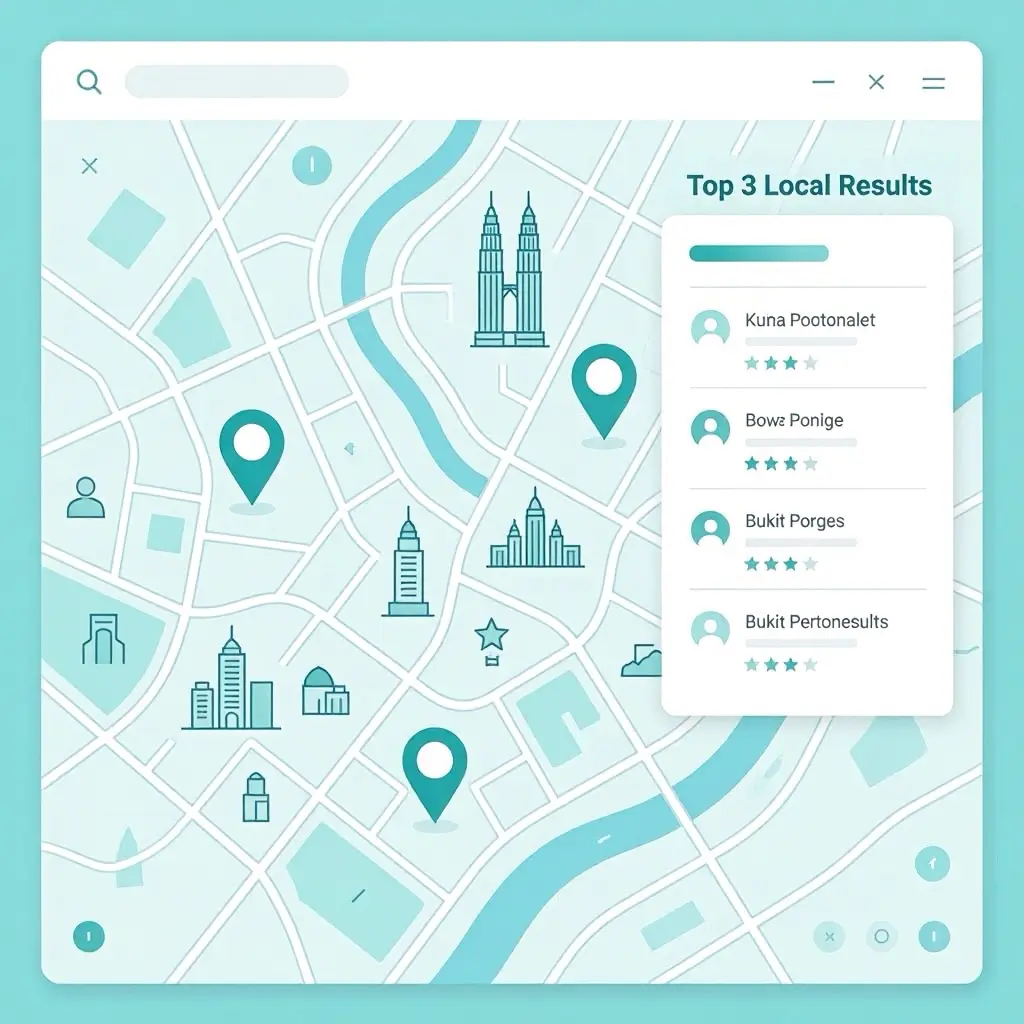
When a potential customer in Kuala Lumpur, Penang, or Johor Bahru searches for a service near them — "accountant near me", "best restaurant in Bangsar", "air cond repair Shah Alam" — Google does not just show a list of websites. It shows a map with three business listings prominently featured at the top. This is the Local Pack, and for local businesses in Malaysia, it is some of the most valuable search real estate available.
Ranking in the Local Pack is the goal of Local SEO. This guide explains exactly how to get there, step by step, for Malaysian businesses.
What Is Local SEO?
Local SEO is the practice of optimising your online presence so that your business appears prominently in Google search results and Google Maps when people nearby search for your products or services. It is a subset of general SEO that specifically targets location-based searches.
Local SEO is critical for:
- Retail stores, restaurants, cafes, and service outlets
- Professional services (lawyers, accountants, doctors, dentists)
- Home services (electricians, plumbers, renovation contractors)
- Any Malaysian business that serves customers in a specific city, town, or region
If your customers can walk in, call you, or visit your premises — Local SEO directly affects how many of them find you.
Why Local SEO Matters for Malaysian Businesses
The numbers are compelling:
- Over 46% of all Google searches have local intent — people are looking for something nearby.
- 76% of people who search for something nearby on their smartphone visit a related business within 24 hours.
- 28% of local searches result in a purchase.
- Google Maps is the default navigation and discovery tool for most Malaysians searching for local businesses.
Despite this, the majority of Malaysian SMEs have either an unclaimed or poorly optimised Google Business Profile. This means there is a genuine competitive opportunity right now — businesses that invest in Local SEO can achieve strong Google Maps rankings relatively quickly compared to traditional organic SEO.
Step 1: Claim and Optimise Your Google Business Profile
Your Google Business Profile (GBP) — formerly known as Google My Business — is the single most important Local SEO asset for your business. It is the profile that appears in Google Maps and the Local Pack when people search for businesses like yours.
To get started:
- Go to business.google.com and search for your business. If it exists (Google sometimes auto-generates profiles), claim it. If not, create a new profile.
- Complete every section of your profile — name, address, phone number, website, hours, category, description, and attributes. Completeness is directly correlated with rankings.
- Choose the most accurate primary category for your business. This is one of the strongest ranking signals Google uses.
- Add high-quality photos of your business, team, products, and premises. Profiles with photos receive significantly more clicks and direction requests.
- Verify your business through the method Google provides (usually postcard, phone, or video verification).
Important: NAP Consistency
Your business Name, Address, and Phone number (NAP) must be identical everywhere it appears online — your website, Google Business Profile, social media, and directories. Even minor inconsistencies (e.g. "Jalan" vs "Jln") can weaken your local rankings.
Step 2: Build Local Citations
A local citation is any online mention of your business name, address, and phone number. Search engines use citations to verify that your business is legitimate and where you say it is. The more consistent citations you have across reputable directories, the stronger your local authority.
Key Malaysian and international directories to list your business on:
- Malaysia-specific: FourSquare, Waze Business, Yellow Pages Malaysia (yellobiz.com.my), Malaysian Business Directory, SME Corp listing
- Industry directories: Legal firms on Cari.com.my, medical clinics on DoctorOnCall, F&B on Zomato and OpenRice
- International: Bing Places, Apple Maps, Facebook Business Page, LinkedIn Company Page
When building citations, always use exactly the same NAP format as your Google Business Profile. Avoid paying for low-quality bulk citation services — a small number of high-quality, relevant citations is more valuable than hundreds of spammy directory listings.
Step 3: Generate and Respond to Customer Reviews
Google reviews are one of the most powerful Local SEO signals. Businesses with more positive reviews consistently outrank those with fewer — and they convert more searchers into customers. Potential clients in Malaysia actively read reviews before contacting a business.
How to generate genuine Google reviews:
- Ask directly — after completing a job or service, send your customer a direct link to your Google review page via WhatsApp or email. Most happy customers will leave a review if the process is easy.
- Add a QR code at your premises or on invoices that links directly to your Google review form.
- Include a review request in your email signature and on your website.
- Respond to every review — both positive and negative. Google takes engagement with reviews as a positive signal, and professional responses to negative reviews build trust with potential customers.
Never purchase fake reviews. Google actively detects and removes them, and your profile can be penalised or suspended.
Step 4: Optimise Your Website for Local Keywords
Your website supports your Google Business Profile by providing additional relevance signals. To optimise for local search:
- Include your city or region naturally in your page titles, headings, and body content (e.g. "SEO consultant Kuala Lumpur", "accountant Petaling Jaya").
- Create a dedicated Contact page with your full business address, phone number, and an embedded Google Map.
- If you serve multiple locations in Malaysia, create a separate page for each key location — do not stuff all locations onto a single page.
- Implement LocalBusiness schema markup on your website so Google can read your business information in a structured way.
- Embed your Google Maps listing directly on your Contact or About page.
Step 5: Earn Local Backlinks
Links from other reputable local Malaysian websites strengthen both your general SEO and your local rankings. Focus on:
- Local news and media — press releases, community events, or expert commentary in Malaysian publications
- Industry associations — Malaysian Chinese Chamber of Commerce, MATRADE, SME Corp, relevant trade associations
- Local sponsorships — sponsoring local events, sports teams, or community initiatives often earns a website mention and link
- Business partnerships — cross-linking with complementary local businesses
Common Local SEO Mistakes Malaysian Businesses Make
Avoid these common errors that undermine local rankings:
- Inconsistent NAP details — your business name, address, and phone number vary across different platforms.
- Ignoring the Google Business Profile — leaving it unclaimed, incomplete, or updating it infrequently.
- Using a PO Box or virtual office address — Google requires a genuine physical location for most business categories.
- Not responding to reviews — especially negative ones, which can damage your reputation if left unaddressed.
- Keyword stuffing in the business name — adding keywords to your GBP name that are not part of your actual business name violates Google guidelines and can lead to suspension.
- Neglecting mobile optimisation — the majority of local searches in Malaysia happen on mobile devices. A slow or poorly formatted mobile website loses local customers.
How Long Does Local SEO Take to Work?
Local SEO typically shows results faster than general SEO. For a previously unclaimed or incomplete Google Business Profile, optimisation improvements can produce visible Google Maps ranking gains within 4 to 8 weeks. Review accumulation and citation building contribute to ongoing improvement over 3 to 6 months.
The competitive landscape matters. In less competitive Malaysian markets or niches, strong Google Maps positions can be achieved relatively quickly. In highly competitive categories (e.g. restaurants in Bangsar, legal firms in KL City Centre), sustained effort over 6 to 12 months is typical.
Before investing in Local SEO, it is worth conducting a full SEO audit of your website to ensure technical fundamentals are in place. Local SEO efforts are amplified when your website is technically sound and loads quickly on mobile.
Frequently Asked Questions
What is Local SEO in Malaysia?
Local SEO in Malaysia is the process of optimising your online presence so your business appears in Google Maps and local search results when Malaysians nearby search for your products or services. It involves optimising your Google Business Profile, building local citations, generating customer reviews, and ensuring your website signals your location clearly to Google.
How do I get my business to appear on Google Maps?
Claim and verify your Google Business Profile at business.google.com, fill in every section completely, add photos, choose the correct category, and ensure your NAP details are consistent across all platforms. Once verified, actively collect genuine customer reviews and keep your profile up to date.
Can I do Local SEO myself or do I need an agency?
The foundational steps — claiming your GBP, ensuring consistent NAP, requesting reviews — can be done yourself and should be done immediately regardless. For competitive markets or if you want to accelerate results, working with an experienced SEO consultant who understands the Malaysian market will produce faster and more sustainable rankings.