
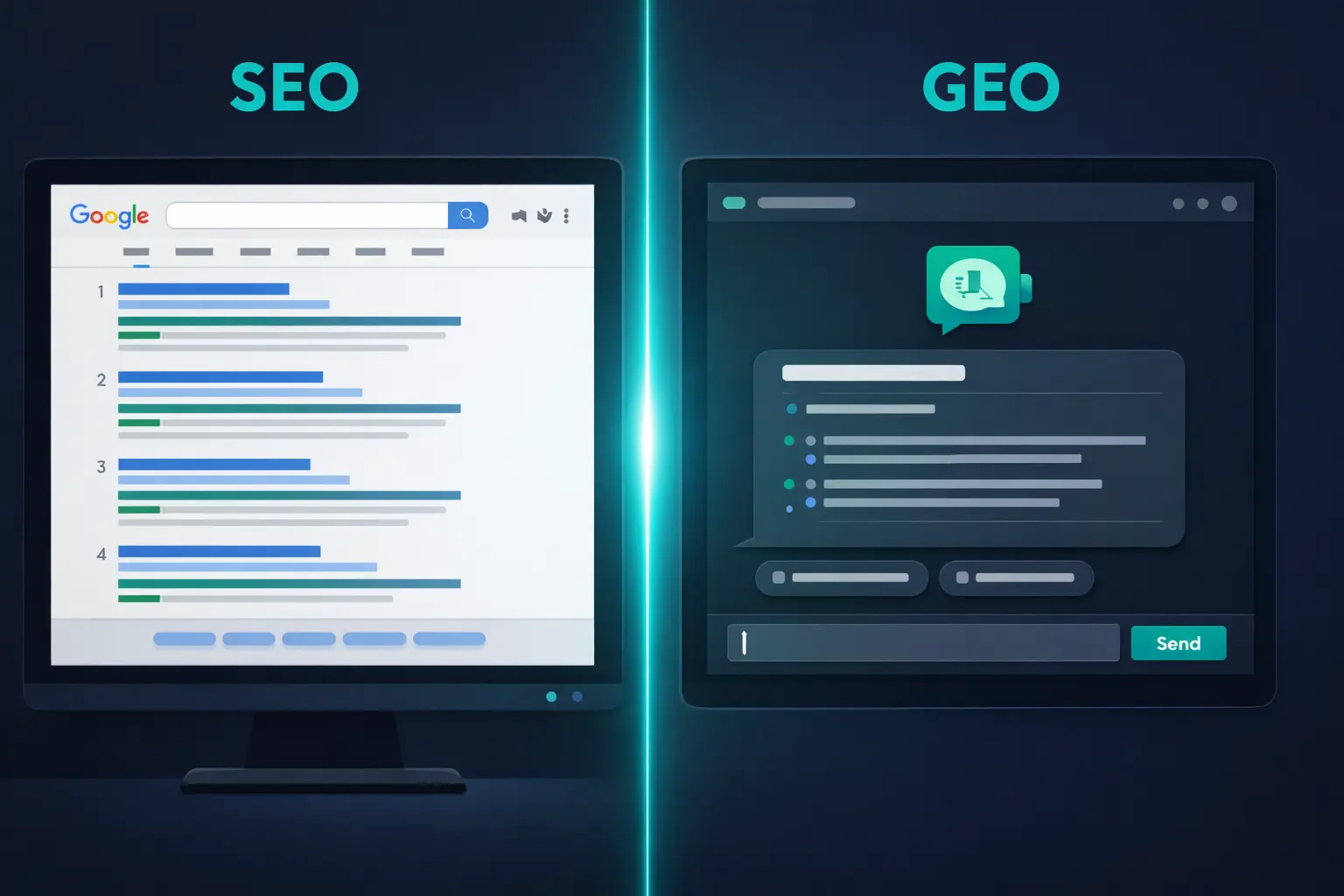
If you have been following digital marketing trends lately, you may have come across a new term: GEO — Generative Engine Optimisation. It sounds like yet another buzzword, but this one is different. It represents a real shift in how people find information online, and it has direct implications for Malaysian businesses investing in search visibility.
This article breaks down what SEO and GEO actually are, how they differ, and what you should be doing in 2026 to make sure your business shows up — whether in Google's traditional search results or in AI-generated answers.
What Is SEO?
Search Engine Optimisation (SEO) is the practice of improving your website so that it ranks higher on search engines like Google. When someone types "SEO consultant Malaysia" or "best accounting firm Kuala Lumpur" into Google, SEO is what determines which websites appear at the top.
SEO works across three main pillars:
- Technical SEO — making sure Google can crawl, index, and understand your website.
- On-page SEO — optimising your page content, headings, metadata, and internal links for target keywords.
- Off-page SEO — building authority through backlinks and brand mentions from other reputable websites.
SEO has been the foundation of organic digital marketing for over two decades. For Malaysian businesses, it remains one of the highest-ROI digital channels — organic traffic compounds over time, unlike paid ads that stop the moment you stop paying.
If you want a deeper grounding in SEO fundamentals, read our guide: What Is SEO and Why Does It Matter for Malaysian Businesses.
What Is GEO?
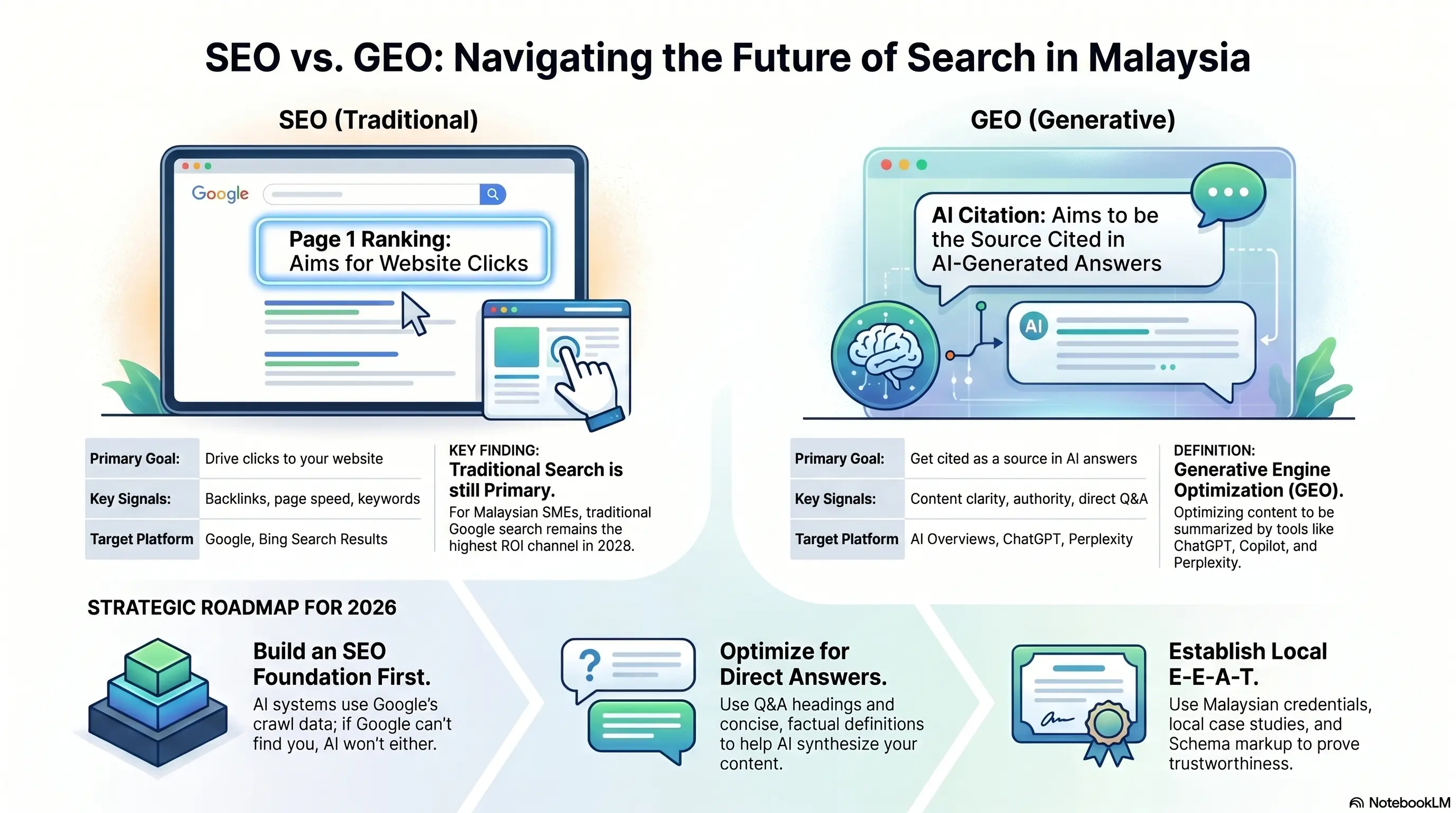
Generative Engine Optimisation (GEO) is the practice of optimising your content so that it gets cited, referenced, or summarised by AI-powered search tools — such as Google's AI Overviews, ChatGPT Search, Microsoft Copilot, and Perplexity AI.
These AI tools do not just rank your page and send traffic to it. They read your content, synthesise it, and present a direct answer to the user — sometimes without the user clicking through to your website at all. GEO is about making sure your brand and content are the source being cited in those AI-generated answers.
Think of it this way: SEO gets you on the first page of Google. GEO gets your content inside the answer box.
SEO vs GEO: Key Differences
| Factor | SEO | GEO |
|---|---|---|
| Target platform | Google, Bing search results | AI Overviews, ChatGPT, Copilot, Perplexity |
| Primary goal | Rank on page 1, drive clicks to your site | Get cited as the source in AI answers |
| Traffic type | Direct website visits | Brand impressions + selective clicks |
| Key signals | Backlinks, page speed, keyword relevance | Content clarity, authority, structured answers |
| Content format | Long-form pages, blog articles, landing pages | Direct Q&A, statistics, expert definitions |
| Maturity | Established — 25+ years of best practices | Emerging — still evolving rapidly |
| Malaysian relevance | High — most Malaysians still use traditional search | Growing — AI tool adoption rising among professionals |
Why GEO Matters for Malaysian Businesses in 2026
You might be thinking: "My customers are not using ChatGPT to find my business." That may be true today. But consider this:
- Google's AI Overviews are already appearing in Malaysian search results for informational queries.
- Professionals and younger decision-makers are increasingly using AI tools to research vendors, compare services, and shortlist suppliers.
- If your competitor is cited in an AI answer and you are not, you are invisible in that moment — no matter how good your traditional SEO is.
GEO is not replacing SEO. It is adding a new layer of visibility that forward-thinking businesses need to account for.
How GEO Works: What AI Systems Look For
AI tools pull from content that is:
- Authoritative — written by someone with real credentials or demonstrated expertise.
- Factual and specific — includes data, statistics, concrete examples, and clear definitions rather than vague generalities.
- Well-structured — uses clear headings, short paragraphs, bullet points, and direct answers to questions.
- Cited by others — content that earns backlinks and brand mentions signals trustworthiness to AI systems, just as it does for traditional SEO.
- Up to date — AI models and retrieval systems favour fresh, recently updated content.
Notice the overlap with traditional SEO best practices? That is not a coincidence. Good SEO and good GEO share the same foundation: high-quality, authoritative, well-structured content.
5 Practical Steps to Optimise for Both SEO and GEO
1. Build a Strong SEO Foundation First
GEO cannot compensate for a technically broken or thin website. Start with a proper SEO audit — fix crawl errors, improve page speed, and ensure your core pages are properly indexed. AI systems rely on Google's crawl infrastructure, so if Google cannot find your pages, neither can AI.
2. Write Content That Directly Answers Questions
AI systems are optimised to answer questions. Structure your content with clear Q&A sections, use headings that mirror search queries ("What is X?", "How does X work?", "X vs Y"), and provide concise, direct answers before expanding with detail. This format is rewarded by both Google's featured snippets and AI-generated overviews.
3. Establish E-E-A-T Signals
Google's concept of E-E-A-T (Experience, Expertise, Authoritativeness, Trustworthiness) is central to both SEO and GEO. For Malaysian businesses, this means:
- Publishing content under a named author with verifiable credentials.
- Including your company registration number and contact details on your website.
- Earning mentions and links from Malaysian industry publications, directories, and reputable websites.
- Including real case studies, client results, and specific local examples.
4. Use Structured Data (Schema Markup)
Schema markup helps both search engines and AI systems understand your content. For service businesses, implement LocalBusiness, FAQPage, and Service schema. For articles and guides, use Article or TechArticle schema. Structured data is one of the clearest signals you can give AI systems about what your content is and who it serves.
5. Build Brand Mentions Alongside Backlinks
Traditional link building focuses on hyperlinks. GEO also rewards unlinked brand mentions — your company or author name appearing in authoritative sources even without a clickable link. Guest articles, expert commentary in industry media, and social proof on reputable platforms all contribute. Our SEO services include off-page authority building that serves both goals.
Should Malaysian SMEs Focus on SEO or GEO Right Now?
For the vast majority of Malaysian SMEs in 2026, the priority order is clear:
- SEO first. Traditional Google search still drives the overwhelming majority of search traffic in Malaysia. Most of your customers are finding businesses via Google search, not AI chatbots. Solid SEO delivers measurable, trackable ROI today.
- GEO as a natural extension. If your SEO content strategy is built on quality, authority, and clear structure — the same principles required for GEO — then you are already doing much of the work. GEO does not require a separate content strategy; it requires raising the bar on the content you are already producing.
The businesses that will be most visible in 2027 and beyond are those building both in parallel today. The cost of doing both is minimal if SEO is already your foundation. The cost of ignoring GEO entirely will compound as AI-assisted search grows.
Summary: SEO vs GEO at a Glance
- SEO = optimising to rank in traditional search engine results and drive website traffic.
- GEO = optimising to be cited in AI-generated answers and overviews.
- Both are built on the same foundation: high-quality, authoritative, well-structured content.
- For Malaysian businesses in 2026, SEO remains the primary focus — but GEO is a necessary evolution, not a distant future concern.
- The best strategy is not to choose one over the other, but to build a content programme that satisfies both.
If you are not sure where your website currently stands — or whether you are positioned to capture either SEO or GEO traffic — a professional audit is the fastest way to find out. Contact us for a free consultation.